
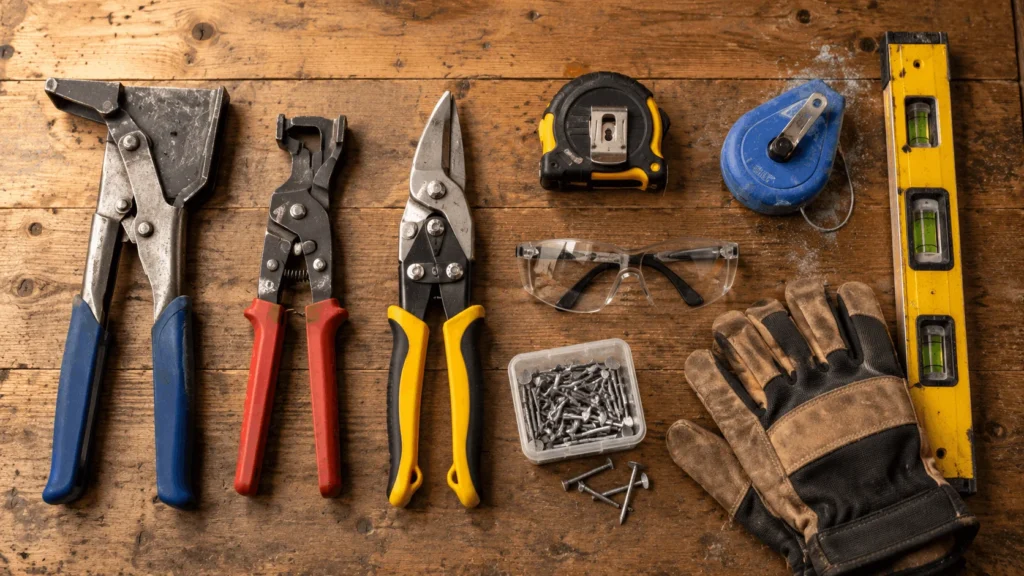
The right siding installation tools turn a frustrating weekend into a clean, straight wall. Vinyl needs a handful of cheap specialty tools, such as a snap lock punch and a zip tool, and fibre cement needs a proper dust-controlled cutting setup. Metal wants its own snips and gloves. This is the full checklist, organized by job, with notes on what is essential, what is nice to have and what you can rent.
We install siding around Canmore and the Bow Valley, and the tool box on our trucks has been refined by years of cold mornings and long ladders. Below you will find the tools we consider essential, the specialty tools each material needs, the safety gear that matters (especially for silica dust), and a short guide to what a first-time DIYer should buy or rent.
✓Key takeaways
- Every siding job needs a tape, level, chalk line, square, utility knife, hammer or siding nailer, ladder or scaffold, and safety glasses.
- Vinyl siding also needs a snap lock punch, a zip tool (unlocking tool), tin or aviation snips or a fine-tooth blade, and loose-driving siding nails.
- Fibre cement needs a HardieBlade or fibre cement blade, dust collection or shears, and a respirator, because cutting releases silica dust.
- Metal siding needs aviation snips or a shear, a fine-tooth metal blade and heavy gloves.
- Rent, do not buy, scaffolding, a compressor and a pneumatic siding nailer if this is a one-off job.
- Buy the cheap specialty tools: a zip tool and snap lock punch cost little and save the most frustration.
In this guide
- The essential siding tools every job needs
- Vinyl siding installation tools
- Fibre cement (Hardie board) installation tools
- Metal, cedar and other siding tools
- Safety gear and ladder equipment
- Which siding tools should you buy, rent or skip?
- Common tool mistakes that ruin a siding job
- A simple starter siding tool kit
- Frequently asked questions
The essential siding tools every job needs
Whatever material you are hanging, these are the tools that keep the wall level, plumb and fastened. If you own only a few of them, start here.
| Tool | What it is for | Notes |
|---|---|---|
| Tape measure (25 ft) | Measuring courses, cuts and openings | Get one with a strong hook and a wide blade. |
| 4 ft level and a torpedo level | Checking level and plumb | A long level is more accurate over a starter line. |
| Chalk line | Snapping the starter line and layout lines | Use blue or yellow chalk that will not stain the wall. |
| Speed square or framing square | Squaring cuts and corners | A speed square is faster for cutting panels and trim. |
| Utility knife with extra blades | Scoring, trimming barrier and cutting some trim | Blades dull quickly, so change them often. |
| Hammer or siding nailer | Fastening into studs | A standard hammer is fine for a small job. |
| Ladder, scaffold or ladder jacks | Reaching the wall safely | The biggest safety decision on the job. |
| Caulk gun and exterior sealant | Sealing trim and joints | Use a sealant rated for your siding material. |
| Pry bar and cat’s paw | Removing old siding and nails | Needed for a tear-off. |
| Safety glasses, gloves, hearing protection | Personal protection | Sharp edges, flying chips and loud saws. |
Layout and measuring tools
A story pole (a straight board marked with every course) is a cheap way to make sure your courses land evenly at the top, under the soffit and at window sills. A laser level or a water level helps you carry a level line around a whole house without accumulated error. A stud finder helps you mark where every stud sits, which matters for fibre cement and any material that has to be fastened into solid framing.
Fastening tools
Small jobs are fine with a hammer. On a whole house a pneumatic siding nailer and a compressor make life easier, but they are also the easiest way to drive nails too tight. For vinyl, in particular, we prefer setting the nailer depth carefully and testing on scrap, because nails must be driven loose enough to let the panel slide. Ask your supplier for corrosion-resistant nails long enough to reach at least 1-1/4 in. into solid wood for vinyl siding.
Tools for old siding removal
If you are tearing off old siding, add a flat pry bar, a cat’s paw, tin snips, a magnetic sweeper for nails, heavy garbage bags or a bin, and a tarp to protect landscaping. Plan your disposal before you start, because siding is bulkier than it looks.
Vinyl siding installation tools
Vinyl is the most tool-friendly siding, and most of what you need is inexpensive. These are the specialty items that separate a clean job from a frustrating one.
| Tool | What it does | Notes |
|---|---|---|
| Snap lock punch (siding lock punch) | Creates raised tabs on cut panel edges so they lock into the panel above | Used wherever you cut off the nailing hem, such as under windows and at the top course. |
| Zip tool (unlocking tool) | Unlocks two panels to fix a mistake or fit the last course | A hooked tool that slides along the lock. |
| Tin snips or aviation snips | Cutting panels, J-channel and trim | Straight-cut and left-cut snips speed up trim work. |
| Fine-tooth blade in a circular saw, reversed | Cutting many panels at once | Go slowly in cold weather, because vinyl gets brittle. |
| Hook-blade utility knife | Scoring and snapping vinyl | Good for straight cuts without a saw. |
| Vinyl siding nail hole slot punch | Making an elongated hole so a panel can move | Used where you need to nail a cut edge. |
If you are new to hanging vinyl, our step-by-step guide to how to hang vinyl siding shows where each of these tools comes into play, and the vinyl siding installation cost guide shows how much of a job’s price is labour and how much is material.
Fibre cement (Hardie board) installation tools
Fibre cement is heavy and dusty, and it needs a different tool set. The most important consideration is silica dust control.
| Tool | What it does | Notes |
|---|---|---|
| HardieBlade or polycrystalline diamond (PCD) blade | Cuts fibre cement cleanly | Wood blades dull quickly and produce more dust. |
| Circular saw with dust collection and a HEPA vacuum | Cutting planks with far less dust | James Hardie ranks a saw with a HardieBlade and dust collection as a preferred cutting method. |
| Fibre cement shears (manual, pneumatic or electric) | Cutting with very little dust | The required approach if you must cut indoors. |
| Score-and-snap knife | Straight cuts on thinner boards | Good for small jobs. |
| Plank carrier | Carrying long boards on edge | Boards crack when carried flat. |
| Siding nailer with the right fasteners | Blind nailing into studs | Set depth so heads are snug, not crushed. |
| Respirator (N95 or better) | Protects against silica dust | Wear it when cutting or sweeping. |
×Watch out
Cutting fibre cement releases respirable crystalline silica. James Hardie’s instructions say not to cut or grind with a power saw indoors, to use dust collection or shears, and never to dry sweep. Wear a NIOSH-approved respirator, such as an N95, if you cannot control the dust. See our full walkthrough on how to install Hardie board siding and the wider fibre cement siding installation guide.
Metal, cedar and other siding tools
Metal siding
For aluminum or steel siding you need aviation snips, a metal shear or a fine-tooth metal blade, heavy leather gloves and safety glasses. Cut edges are razor sharp, and steel cutting throws hot sparks if you use an abrasive wheel, which is another reason we prefer snips or a shear.
Cedar and wood siding
For wood you want a sharp finish blade in your saw, a miter saw for accurate ends, a brad or finish nailer with stainless or hot-dipped galvanized fasteners, a block plane for fit, and sealer and a brush for cut ends. Our guide to installing cedar siding covers why sealing the ends matters so much.
Safety gear and ladder equipment
A good siding kit is half tools and half safety gear, and the most dangerous item on the job is usually the ladder. In Alberta, workers must use fall protection when working at height, generally at 3 m (about 10 ft) or more, and homeowners would do well to treat that as a sensible line for a DIY job too. Check the current Alberta OHS Code Part 9 before you hire or start, and use scaffolding or a proper platform on tall walls.
- Ladder or scaffold: set it on firm, level ground, use ladder stabilizers or standoffs so you are not leaning on the siding, and never overreach.
- Safety glasses: vinyl chips and fibre cement dust are both hard on eyes.
- Respirator: N95 or better for fibre cement and cutting dust.
- Gloves: cut-resistant gloves for metal and general-purpose gloves for vinyl.
- Hearing protection: saws and compressors are loud.
- Footwear: sturdy shoes with grip, especially on frosty mornings.
- Weather awareness: in the Bow Valley, wind and snow can turn a calm job into a risky one quickly.
▲Bow Valley note
Chinook winds can pick up fast in the Bow Valley, and a full sheet of panel or a length of plank on a ladder becomes a sail. We stop lifting long material when the wind gets gusty, and we secure loose stock on the ground before we start each day.
Which siding tools should you buy, rent or skip?
The tools by job stage
The order a crew reaches for them.
- Tear-offPry bar, cat’s paw, magnet, bin.
- PrepKnife, tape, flashing tape, caulk gun.
- LayoutLevel, chalk line, story pole.
- CutSnips, saw, shears, blade.
- FastenHammer or nailer, right nails.
- FinishZip tool, snap lock punch, caulk.
Buy these
- Snap lock punch and zip tool (small cost, big payoff)
- Level, chalk line, tape, square, knife
- Snips and safety gear
- A good hammer or a basic nailer for a small job
Rent or borrow these
- Scaffolding or ladder jacks
- Compressor and pneumatic siding nailer for a full house
- Fibre cement shears or a dust-collecting saw setup for a single job
- HEPA vacuum for fibre cement cutting
If the list feels like a lot for one project, that is a fair sign to price out a professional crew, since our installers already own and maintain all of it. See our siding installation service and the siding installation cost guide to compare doing it yourself with hiring out.
Common tool mistakes that ruin a siding job
- Using a wood blade on fibre cement. It dulls fast, overheats and throws more dust. Use a blade made for the job.
- Setting the nailer too deep on vinyl. Panels must float on their nails, so test the depth on scrap and check that a panel still slides by hand.
- Skipping the zip tool. People try to pry locked panels apart with a screwdriver and crack them. A zip tool costs very little.
- Cutting vinyl in deep cold with a fast, coarse blade. Cold vinyl chips and cracks, so slow down and use a fine-tooth blade.
- Working off a ladder that leans on the siding. Use standoffs so the ladder does not mark or crack the wall.
- Trusting a dull utility knife. A dull blade slips, so swap it before it does.
- Leaving cut vinyl and fibre cement dust on site. Clean up with a vacuum, not a broom, and keep nails out of the lawn with a magnetic sweeper.
A simple starter siding tool kit
- Measure and layout: tape, level, chalk line, speed square, story pole.
- Cut: utility knife, snips or shears, and the right blade for your material.
- Fasten: hammer or siding nailer, corrosion-resistant nails.
- Specialty for vinyl: zip tool and snap lock punch.
- Protect: safety glasses, gloves, respirator if cutting fibre cement.
- Reach: ladder with stabilizers, or a rented scaffold.
- Finish: caulk gun and the sealant recommended for your product.
Frequently asked questions
What tools do you need to install vinyl siding?
At minimum a tape, level, chalk line, square, utility knife, tin or aviation snips, a hammer or siding nailer, a snap lock punch, a zip tool, siding nails, a ladder and safety glasses. A fine-tooth blade in a circular saw, reversed, speeds up cutting.
What is a zip tool used for in siding?
A zip tool (unlocking tool) slides along the lock between two vinyl panels to unlock them so you can fix a mistake or install the last course under the soffit.
What is a snap lock punch?
A snap lock punch makes small raised tabs along the cut edge of a vinyl panel, so it can lock into the panel above where the factory nailing hem has been cut off.
What blade do you use to cut fibre cement siding?
A HardieBlade or another blade designed for fibre cement, such as a polycrystalline diamond blade, on a circular saw with dust collection. Shears and score-and-snap knives are lower-dust alternatives.
Do I need a siding nailer?
No. A hammer works for small jobs. A pneumatic siding nailer speeds up a full house, but it is easy to overdrive nails, so test the depth on scrap first, especially on vinyl.
What safety gear do you need for siding installation?
Safety glasses, gloves, hearing protection and stable footwear for every job, plus a respirator such as an N95 when cutting fibre cement. Use a ladder with stabilizers or scaffolding, and stop work in gusty wind.
Should I rent or buy siding tools?
Buy small specialty tools like the zip tool and snap lock punch. Rent scaffolding, compressors, nailers and dust-collecting saw setups if this is a one-off job.
Would you rather leave the tools to us?
Old Goat Construction installs siding across Canmore and the Bow Valley. Send us your wall and we will give you an honest recommendation on material, timing and cost.
